PLAION unveils all Neo Geo AES+ secrets: 4 ASIC chips, anti-lag patent, anti-counterfeit replica manuals, scanlines and the miracle that saved it from cancellation
Ben Jones (PLAION Replai) breaks down the engineering behind the Neo Geo AES+: four custom ASIC chips instead of FPGA, zero-frame-buffer 60 Hz HDMI output for zero input lag, replica manuals with anti-scalper markings, and the Flash memory redesign that saved the console.
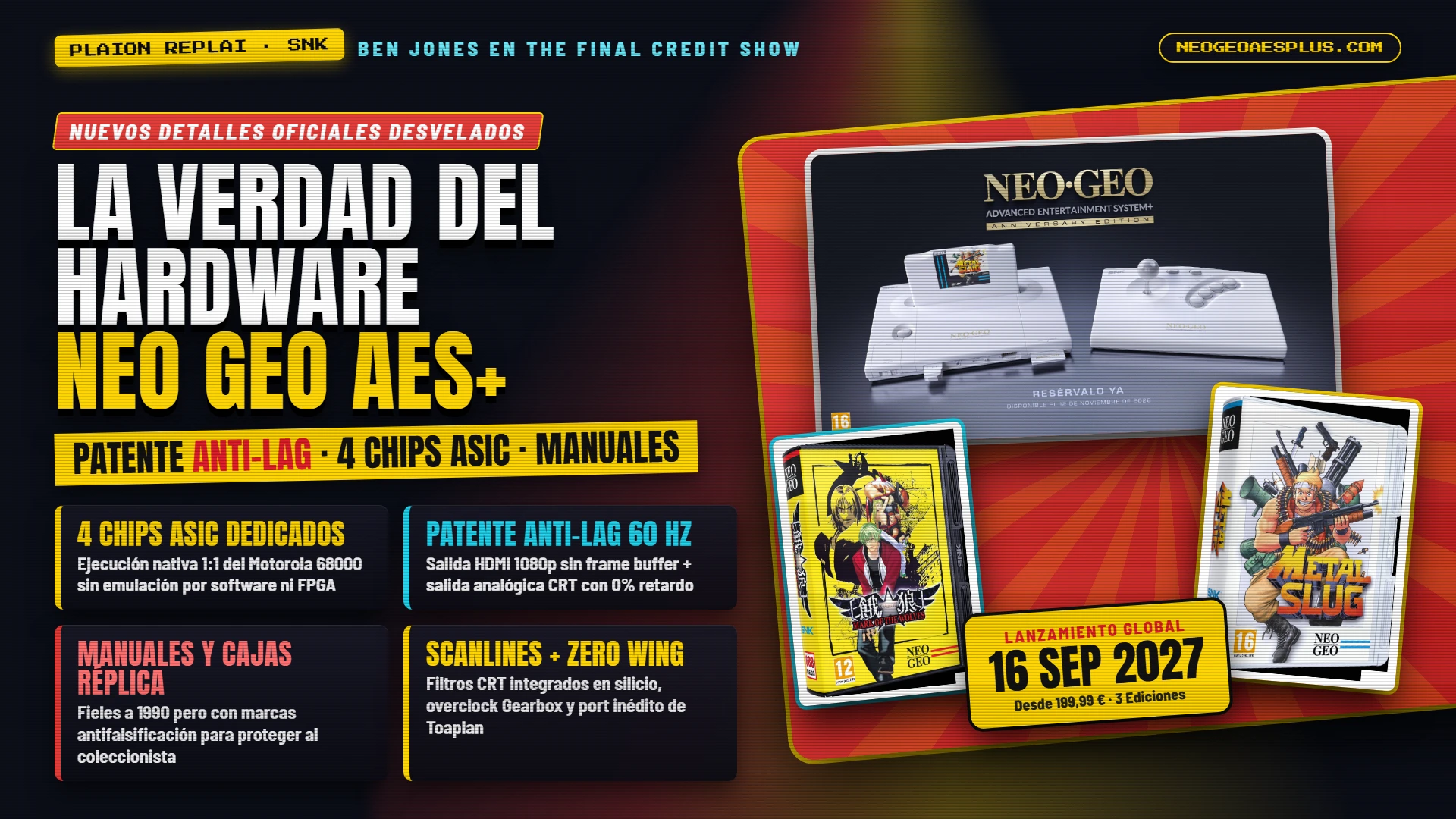
The most ambitious modern retro hardware project continues to deliver major technical revelations. Ben Jones, Commercial Director and head of hardware and software at PLAION Replai for the new Neo Geo AES+, sat down for an in-depth interview on The Final Credit Show (hosted by Project COE), building on his technical demonstrations at EVO France and the Tokyo Game Show. Going far beyond superficial recaps or auto-caption transcription errors seen in mainstream outlets, here is the complete technical breakdown of how SNK's legendary 24-bit powerhouse is being rebuilt for its September 16, 2027 release.
From discarded FPGA to 4 custom ASIC chips: the real engineering dream team
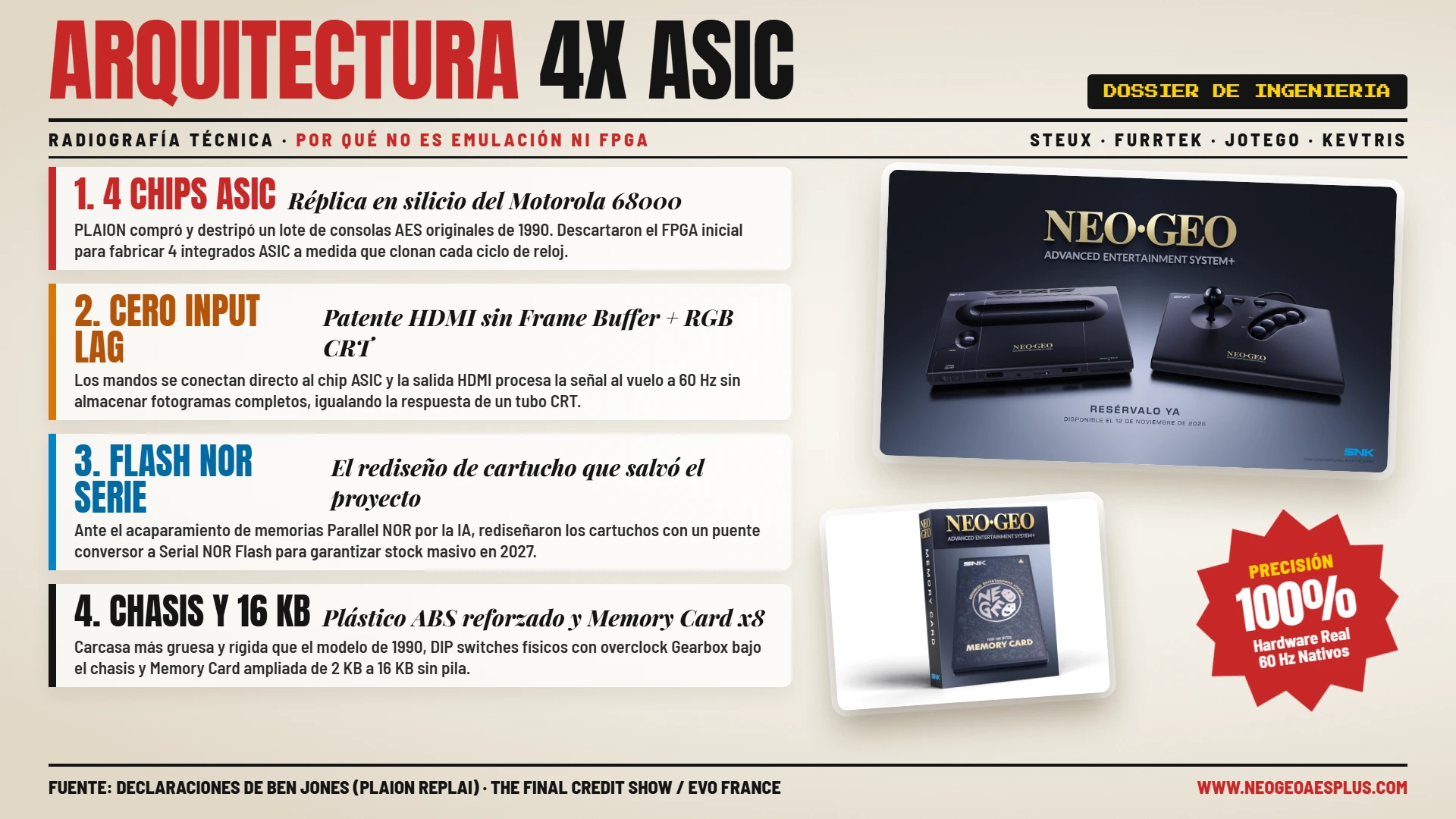
One of Ben Jones's most fascinating revelations is how the console's internal architecture came to be. In the earliest stages, PLAION initially planned to build the console around a conventional FPGA. However, before locking in the design, the company purchased a full batch of original 1990 Neo Geo AES consoles and subjected them to a meticulous silicon-level teardown and reverse-engineering process.
Bringing aboard true legends of the hardware preservation scene — including French engineer Bruno Steux, renowned SNK chip decapping specialist Sean "Furrtek" Gonsalves, silicon core master JOTEGO (José Tejada), and hardware pioneers like Kevin "Kevtris" Horton — enabled a historic leap: moving beyond generic FPGA emulation to fabricate four dedicated custom ASIC chips that replicate the original Motorola 68000 microprocessor, Z80 audio coprocessor, and SNK custom graphics chipset cycle by cycle.
How the console escaped cancellation: the AI memory crisis and the Serial NOR Flash bridge
Ben Jones candidly admitted that the project came perilously close to dying: "Without the solution for the flash memory, I think it would have been all over." When pre-orders far exceeded PLAION's initial projections and the team moved to secure components for mass cartridge production, they hit a wall: the global Artificial Intelligence (AI) data-center boom had wiped out the supply of Parallel NOR Flash memory required natively by the Neo Geo's parallel bus.
Not even a personal trip to Taiwan by Jones could secure enough parallel memory wafers for a 2026 launch. Salvation came from PLAION's own cartridge R&D: because the team had already designed and manufactured thousands of custom ASIC chips for the cartridges, engineers redesigned the cartridge PCBs to use widely available Serial NOR Flash paired with a real-time serial-to-parallel translation bridge. Re-verifying this new cartridge architecture across the entire 106-game classic library is the core technical reason behind the move to September 16, 2027.
60 Hz anti-lag patent and hardware scanlines built straight into the ASIC
For competitive fighting game fans playing Garou: Mark of the Wolves or The King of Fighters 2002, even a single frame of input lag ruins muscle memory. Jones explained that the complete absence of input lag on the Neo Geo AES+ rests on two physical pillars:
- Direct-to-silicon controller routing: The DB15 controller ports wire directly into the ASIC pins, with no intermediate USB polling or Linux/Android software layer.
- Proprietary HDMI output without a full frame buffer: Unlike mini consoles that buffer entire frames before scaling (adding 2 to 4 frames of delay), the AES+ processes its native 60 Hz (60 fps) signal on the fly for crisp 1080p HDMI output with zero added latency, while preserving a pure analog RGB/AV output for CRT monitors.
Following community discussions after EVO France, Jones also confirmed that CRT scanline generation is built directly into the ASIC silicon, giving modern flat-panel displays the authentic aperture-grille look of 1990s arcade monitors. Underneath the reinforced, thicker ABS chassis sit physical DIP switches for video resolution (1080p/720p), aspect ratio (4:3/16:9), HDMI/analog output, and the Gearbox overclocking mode to eliminate classic sprite slowdown in titles like Metal Slug 2.

Replica manuals included with every game — engineered to stop second-hand scammers
Every physical launch cartridge (€79.99 RRP, on sale from €74.99) will ship inside a snap-lock case complete with a printed instruction manual modeled after the original 1990s release.
Crucially, Ben Jones noted that neither the manual, nor the box insert, nor the cartridge shell will be 100% identical to vintage 1990 printings. Why? To protect collectors from counterfeiters and scalpers on the second-hand market. With original AES cartridges routinely selling for €1,500 to €3,000+, PLAION is intentionally embedding subtle visual distinctions so no scammer can pass off a €79.99 AES+ reissue manual or cart as a vintage 1990 original.
From Zero Wing to the Scotland course in Big Tournament Golf
Jones also shared the stories behind the expanding cartridge lineup alongside the 10 launch classics and the newly announced Data East wave:
- The Zero Wing port: Toaplan's iconic 1989 horizontal shooter (famous for "All your base are belong to us") never released on the original Neo Geo. Demoscene coder Ian "Hoffman" Ford was independently porting it because Toaplan's arcade board shared the Motorola 68000 CPU. Since Toaplan's IP (via Tatsujin) and PLAION both sit under the Embracer Group umbrella, his passion project became an official physical launch cartridge for Neo Geo AES+.
- The exclusive Scotland course in Big Tournament Golf (Neo Turf Masters): Previously exclusive to the Neo Geo CD version, the Scotland course was grafted directly into the AES+ cartridge ROM after three months of dedicated engineering and QA testing.
- 16 KB battery-free Memory Card: Storage jumps eightfold from the original 2 KB to 16 KB without requiring a coin-cell battery, while deliberately leaving out save states or rewind features to preserve the pure arcade challenge.
Why the base bundle is €199.99 and how the three editions compare
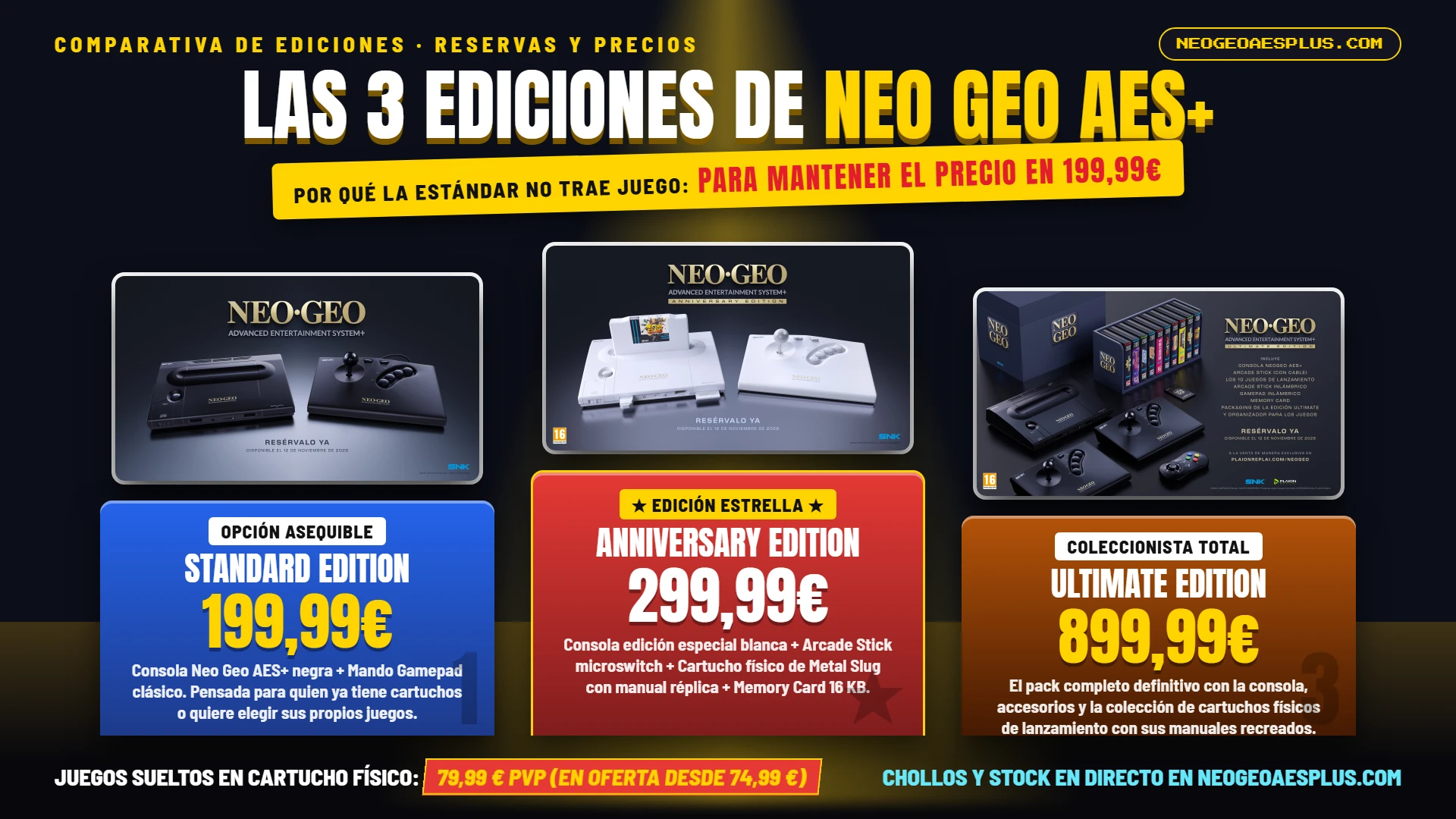
Finally, Jones explained why the base console ships with a controller rather than a bundled game: keeping the entry price at €199.99 amidst surging component costs, giving existing cartridge owners an affordable way to jump in:
- Neo Geo AES+ Standard Edition (€199.99 RRP): Classic black Neo Geo AES+ console, microswitch controller, HDMI cable, and power supply.
- Neo Geo AES+ Anniversary Edition (€299.99 RRP): Special white 35th Anniversary console, wireless white Arcade Stick, physical Metal Slug cartridge with replica manual, and 16 KB Memory Card.
- Neo Geo AES+ Ultimate Edition (€899.99 RRP): The complete collector's bundle featuring the console, all official controllers, Memory Card, and all 10 launch game cartridges with replica manuals.
Pre-order price guarantee · Releases September 16, 2027
Published: October 26, 2026